

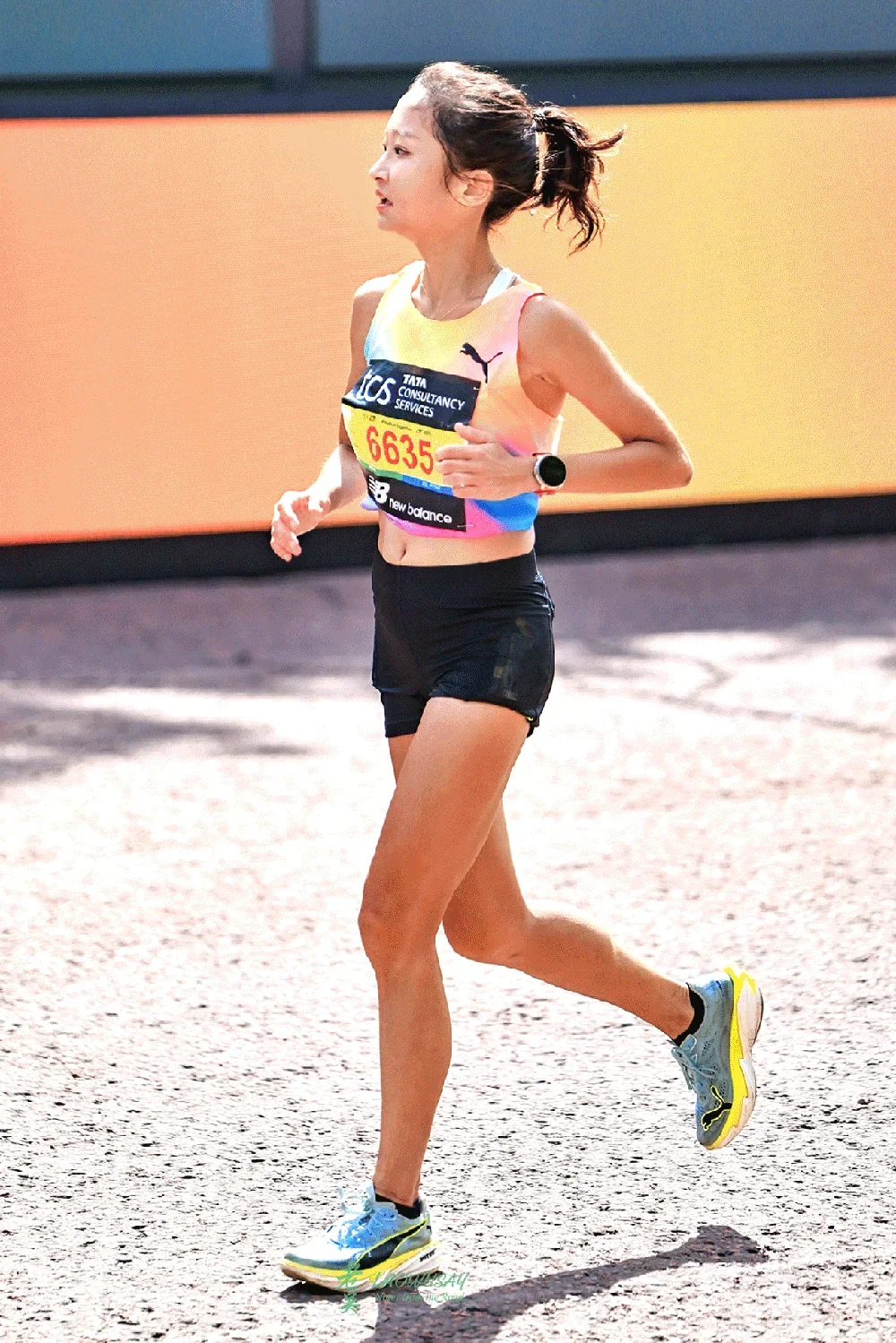
On April 26, Fei Fei ran her third London Marathon. Around the ten-kilometer mark, news spread that Savi and Kjeller had broken the two-hour mark in the same race. The crowd erupted, and the excitement swept through every runner on the course. Fei Fei felt a surge of emotion but didn’t think about pushing harder.
Over eight years of running, she has experienced every common injury a runner can face and endured the toughest challenges. By now, she knows which races to give her all and which ones to let go.
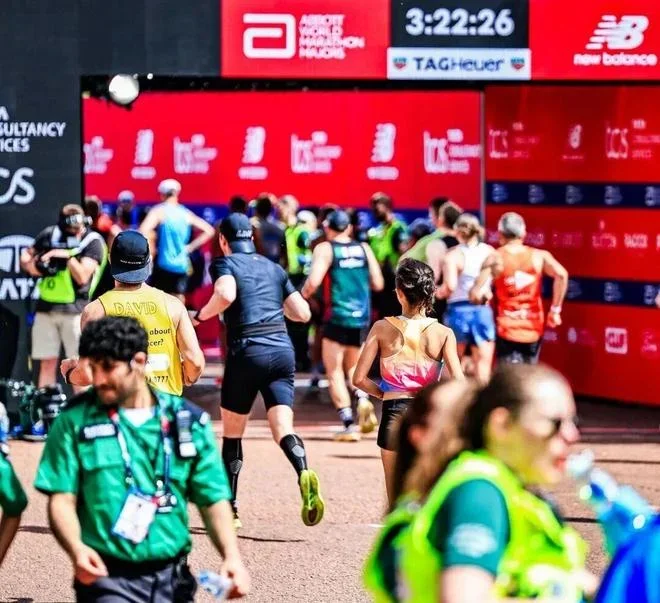
A month after achieving her sub-three goal, Fei Fei ran the London Marathon, conquering the mental hurdle of failing to finish the race twice before.
She had just completed the Shijiazhuang Marathon on March 29 in 2:59:45, reaching her sub-three target. Her coach, Anna, strongly opposed her running London so soon, calling it an unscientific schedule with two marathons in a month. Fei Fei promised she had no time goal and just wanted to break the “mental block” from her two previous DNFs in London. Only then did Anna relent.
“After this, I have no other races planned. I’ll be competing in the Singapore National Championships later this year, so I need to be careful,” Fei Fei said.
From the bottom of the running group to a 2:59 PB
Twice she missed sub-three by narrow margins
On March 29, before the start of the Shijiazhuang Marathon, the national anthem was played. Fei Fei, in the B corral, started singing along and choked up immediately. “I cried again, so embarrassing,” she admitted.
This was her third serious attempt to break three hours. The first was at the Chicago Marathon the previous year, missing by 2 minutes and 30 seconds. The second was at the Chongqing Marathon on January 8, missing by just 8 seconds.
After the Chicago race, she was disheartened. “A whole year of hard work, and I improved by only 45 seconds,” she recalled. She felt she gave up too early—after the 30K mark, she told herself she wasn’t going to make it and stopped pushing, hitting every aid station unnecessarily. “I could have saved two minutes by skipping a couple of stops. Maybe that would have been enough.” She also acknowledged she had taken gels at the wrong time; she should have consumed 60-80 grams of carbs per hour instead of waiting until she felt depleted. She also chose the wrong type of gel.
“I should have picked a more comprehensive one,” she reflected. A week after Chicago, she documented these memories on her Xiaohongshu account, a habit she developed during her part-time MBA. “I don’t write immediately. I wait until my emotions settle, so I can see the full picture clearly.” She prefers to call it “recalling” rather than “reviewing” because “some moments are not meant to be analyzed, but to be felt again.”
One week before the Chongqing race, she did not taper, and the day before, she walked nearly 30,000 steps around the city. Fei Fei believes this was the main reason she failed to break three again.
After the Chicago disappointment, she decided to try again at Chongqing. She tested her race nutrition twice and switched to a more comprehensive gel. Yet she still missed by eight seconds. “Eight seconds!” she said, half-laughing. In her recall, she wrote: “Nutrition was fine; I had mental wobbles but overcame them every time. The problem? Direct cause: I walked nearly 30,000 steps in Chongqing the day before. But the root cause was not tapering the week before. Same old mistake!” She realized that a runner who cannot rest is not a qualified runner.
Two months later, Fei Fei and Coach Anna traveled to Shijiazhuang. This time, she tapered properly. The day before the race, she stayed in, took a short walk after dinner, and went to bed early. The course was flat. Coach Anna and her husband ran alongside Fei Fei the whole way. Her watch kept warning about high heart rate, but she refrained from looking. Several times in the second half, she wanted to give up, but whenever her pace dropped, Anna urged her to hold on. She gritted her teeth and pushed. The dry air burned her throat and nose, her heart pounded, her legs ached. She felt like a mindless running machine.
With less than 5K to go, her mind went numb, just like her legs. Anna remained steady, and Fei Fei only had to follow. Four kilometers, three, two, one—each vibration from her watch marked a countdown. Then she saw the arch. She had broken three hours.
She expected to cry, but didn’t. Instead, a wave of calm washed over her. She rested against the fence behind the finish line for a while, then hugged Anna and took photos. “Finally, I can take a break!” was her only thought.
Fei Fei is very slim and eats whatever she wants without gaining weight. Some people say she has a natural marathon physique, but she dislikes that characterization.
She clearly recalls her first physical test in high school: 2.4 kilometers in 16 minutes. “It was a nightmare. Probably because I wasn’t used to the environment,” she says. She moved to Singapore after middle school. In China, girls only ran 800 meters in school tests, which was easy for her. But in Singapore, the test distance jumped to 2.4 kilometers right away. “I had no long-distance running experience at all.”
As a teenager, Fei